Sophie Mol’s drowning
The God of Small ThingsSophie Mol’s drowning is the fatal reversal at the heart of the children’s nighttime escape: a journey meant to make the adults recognize their absence ends with Sophie Mol lost in the Meenachal River. The boat overturns in darkness after striking a floating log. Estha and Rahel survive, but cannot find Sophie Mol; by the time they reach the History House before dawn, the river has carried her away. The narration withholds spectacle from the death, presenting it instead as a quiet passage from the children’s imagined return to a consequence none of them can undo.
The escape and its purpose
The crossing begins with the twins’ boat, hidden in the bushes, and the paddles Velutha had made for them. Estha and Rahel drag the boat out, set it on the water, and steady it while Sophie Mol climbs in. She is more hesitant than the twins, and carries a cloth bag of food taken from the refrigerator. The twins bring supplies they have accumulated for their refuge: matches, potatoes, a battered saucepan, an inflatable goose, socks with multicolored toes, and pens decorated with London buses and a Qantas koala. Their preparations make the escape feel like a small, provisioned expedition, even as the children’s confidence rests on a fragile understanding of what will happen next.
Sophie Mol has persuaded them that she must go too. If all the children disappear, she reasons, the adults will feel greater remorse; after searching and believing the children dead, the adults will welcome them back as loved and needed. She also argues that, left behind, she might be tortured into revealing where the twins are hiding. Her idea turns their flight into a plan for recognition and reunion. The children do not set out intending to abandon Sophie Mol: she insists on joining them, and they make room for her in the boat.
Estha waits until Rahel is aboard, then straddles the little boat and pushes it from shore with his legs. The children row diagonally upstream, against the current, following the direction Velutha taught them. In the dark, they cannot see that they are in the wrong lane of a river carrying branches, logs, and broken pieces of trees downstream. A lesson about where to aim is no protection against what the children cannot see.
The capsize and disappearance
They are past the Really Deep and only yards from the opposite bank when the boat hits a floating log and tips over. On earlier crossings, the children had been able to swim after the boat and use it as a float. This time, darkness prevents them from seeing it, and the current sweeps it away. The loss of their boat also takes with it their means of crossing and the practical shelter of their carefully prepared journey.
Estha catches a low branch arching into the water and looks downstream, but cannot see the boat. Rahel, coated in slush, reaches the bank and holds out a hand to help him climb out. After catching their breath, the twins register that the boat and their food are gone. When Rahel calls to Sophie Mol near the illimba tree, there is no answer. The narrative marks the change through that unanswered call: the children have made it ashore, but their companion is no longer with them.
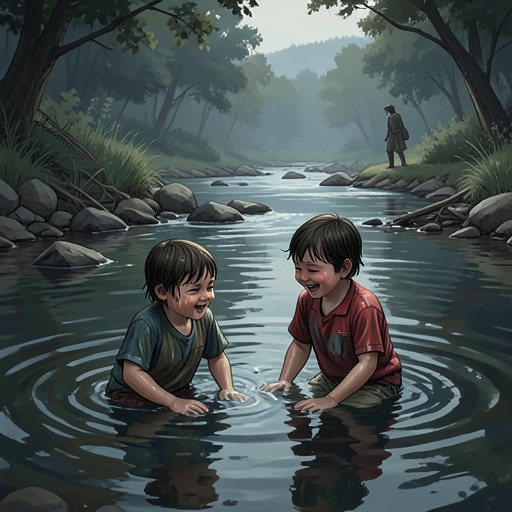
The twins run along the bank calling for Sophie Mol, but she is gone, carried away by the river. The account refuses a dramatic natural explanation: there is no storm music, whirlpool, or shark. Instead, the death is rendered as a quiet exchange between the capsized boat and the current, with Sophie Mol’s little body carried away holding a silver thimble for luck. The restrained description makes the tragedy more devastating, not less; the river does not announce the change that has turned a children’s escape into a death.
Discovery and immediate aftermath
At four in the morning, exhausted, distraught, and covered in mud, Estha and Rahel leave the swamp and reach the History House. They lie on the back verandah on a grass mat with the inflatable goose and a Qantas koala bear. The objects that had belonged to their imagined refuge remain with them, but now accompany two frightened children who have lost Sophie Mol and cannot make sense of what has happened. When Rahel asks whether Sophie Mol might be dead by then, Estha does not answer.
The family does not learn of the drowning at the riverbank. At about nine that morning, Mammachi and Baby Kochamma hear that the body of a white child has been found floating downriver where the Meenachal broadens toward the backwaters. Estha and Rahel are still missing. Earlier, the three children had failed to appear for their morning milk; Mammachi and Baby Kochamma thought they might have gone swimming, a dangerous possibility after heavy rain. They send Kochu Maria to search, but she returns without them. In the upheaval after Vellya Paapen’s visit, no one can recall when the children were last seen, and they may have been missing throughout the night.
The discovery confirms what the children could not know with certainty in the dark: Sophie Mol has drowned. Her body’s appearance downstream turns absence into public fact, while the twins remain unaccounted for. The gap between the night crossing and the morning news also makes clear how thoroughly the family has lost track of the children at the very moment their lives have become most vulnerable.
Consequences and narrative significance
The drowning is not an isolated accident detached from the family’s conflicts. The children’s escape is partly a response to the painful words Ammu has spoken to them, and Sophie Mol joins because she believes her disappearance will make the adults value them. The plan imagines remorse followed by a triumphant return; the river replaces that hoped-for sequence with a death, the twins’ survival, and a morning in which the family must confront both the body and the children’s disappearance. The difference between the children’s expected homecoming and the actual outcome is the event’s decisive reversal.
The catastrophe also becomes a hinge in the twins’ lives. After Sophie Mol’s funeral, Estha is returned to his father and sent to a boys’ school in Calcutta. He is described as an average student, with teachers repeatedly noting that he does not participate in group activities. His later silence is not assigned one exact beginning: it gradually winds down until he stops speaking altogether, and he becomes so unobtrusive that strangers may not notice either his presence or his silence. The novel connects the drowning’s aftermath to a long retreat from ordinary participation without reducing that retreat to a single moment or a simple explanation.
The loss continues to shape the adults as well. Margaret Kochamma never forgives herself for bringing Sophie Mol to Ayemenem and leaving her there over the weekend while she and Chacko go to Cochin to confirm their return tickets. Ammu’s later death in a grimy room at the Bharat Lodge in Alleppey occurs when she is thirty-one, alone, without Estha beside her. The separations that follow Sophie Mol’s death do not restore the family; they deepen the consequences of the night crossing.
The narration’s later return to the twins, twenty-three years on, places the drowned child within a much longer history of loss. The event’s central irony remains sharply local: a little boat, familiar crossings, and children hoping to be valued are overtaken by a river swollen after rain. Nothing in the scene offers a grand storm or a purposeful villain to explain the outcome. Its force lies in the small, specific change from three children setting out together to two children reaching shore without the third, and in the years of separation and silence that follow.